
This type of loan works by allowing homeowners to convert a percent of their house's equity into cash without the need to sell their house or make regular monthly payments. Borrowers must meet loan obligations, like keeping current with property taxes, insurance, and maintenance.
Unlike a typical forward mortgage, where the borrower must begin repaying the loan immediately, borrowers do not have to pay off funds received through a HECM until a maturity event occurs, such as after the final borrower stops living in the home.1 There are no monthly loan payments required.2
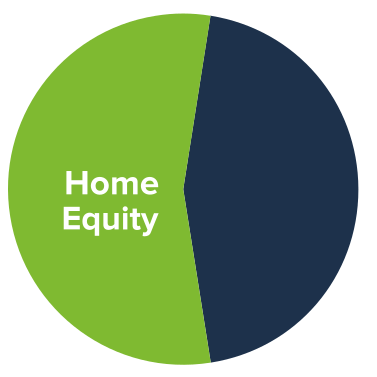
For many retirees, their house is their most important asset and the one they have invested the most in throughout their lives. In fact, today’s seniors hold record amounts of home equity.3
HECM loans work by allowing homeowners to tap into their home’s equity while still living in their house well into the retirement years.2 More than 1.3 million Americans have already made a HECM loan a powerful part of their retirement plan.4

Reverse vs. Traditional Mortgage
When it comes to traditional and reverse mortgages, there are several differences and similarities. While classic mortgages require homeowners to make consistent payments toward their mortgage balance every month for many years, reverse mortgages do not require homeowners to make any monthly mortgage payments.2
Similarities:
- The homeowner maintains deed and ownership of the house.2
- The homeowner is responsible for property taxes, insurance, and maintenance.
- Loans are secured by notes and deeds.
- Closing costs for a HECM are similar to those for a typical (forward) mortgage.
Differences:
- HECM loans do not require monthly loan payments to be made.2
- The credit line for a Home Equity Conversion Mortgage can never be reduced; it increases over time, regardless of loan balance or home value.5
- The borrower will never be asked to repay more than the home is worth when the home is sold and the loan is repaid (non-recourse loan).
- Borrowers are required to be 62 years of age or older in order to qualify for a Home Equity Conversion Mortgage.
According to the Federal Housing Authority (FHA) regulations, there are more aspects regarding how a HECM loan works.
Borrowers are required to use the home as their primary residence while maintaining the home in satisfactory condition. Borrowers applying for a HECM loan must also attend independent FHA-approved counseling as part of the loan process.

How Can You Use Reverse Mortgage Funds?
The cash you get from a reverse mortgage can be used for anything you’d like. We provide several ways for receiving proceeds and how you decide to use the funds depends on your personal financial situation and retirement goals. If you have a current mortgage on the home, the funds from the Home Equity Conversion Mortgage will first be used to pay off the loan. The remaining money can then be received in any of the following distribution methods:
- A single payment, income tax-free.4
- Steady, income tax-free monthly payments.4
- A credit line, as a “safety net” for later use if needed.
- A combination of these methods.6
Every borrower is unique, and our clients have found creative ways to use a HECM loan to improve their lifestyle and monthly cash flow. These are just a few illustrations of how Home Equity Conversion Mortgages work to your advantage:
• Lower your total taxable income: avoid making taxable withdrawals from 401(k) or other retirement plans by replacing the funds with income tax-free HECM funds.7
• Establish a line of credit for emergencies or occasional expenses.
• Keep extra cash available to cover regular expenses and bills.
• Manage credit card balances or consolidate other debts.
• Assist with medical bills, making it easier to “age in place.”
• Set aside cash to assist in paying for long-term care down the road.
• Make modifications, improvements, or repairs to your home to live more comfortably.
• Help a family member with large expenses, such as a down payment on a home or college tuition.

Can My Heirs Keep the House?
Yes. One of the positives of Home Equity Conversion Mortgages is that the program provides your children with the option to arrange alternative financing, pay off the reverse mortgage, and keep the house. However, the money to repay the HECM loan typically comes from the sale of the house itself, once the home passes to your heirs.
In the rare event that the amount of the HECM loan repayment is higher than the house is worth, neither your heirs nor you will be obligated to repay the difference.
Can I Get Rid of Monthly Mortgage Payments?
Yes.2 If there’s a conventional mortgage on your home, the cash from the reverse mortgage is first used to repay that loan. As no monthly mortgage payments are required on the HECM2, you can eliminate that monthly bill and keep more funds to use as you see fit.
One of the largest benefits of reverse mortgages is that repayment is delayed. This means that repayment of the loan is not due until a maturity event, such as after the final borrower no longer resides within the home. The decision is yours on whether or not you would like to pay off the HECM ahead of time. You will not have early payment penalties with HECM loans. And with discretionary mortgage payments2, you have the freedom to pay as little or as much as you would like, as often as you would like.
How Much Cash Can I Receive from a Reverse Mortgage?
There are many elements that go into determining how much of your house’s equity you can convert to cash with a reverse mortgage. Your home's appraised value, age, and current interest rates are all taken into consideration. Often, the amount of money you can qualify for will be between 50% and 70% of your home’s value. Contact me to get your free, no-obligation, personalized quote.
